
Stuck or Stabilizing? The Complete Guide to Understanding Your Business Season

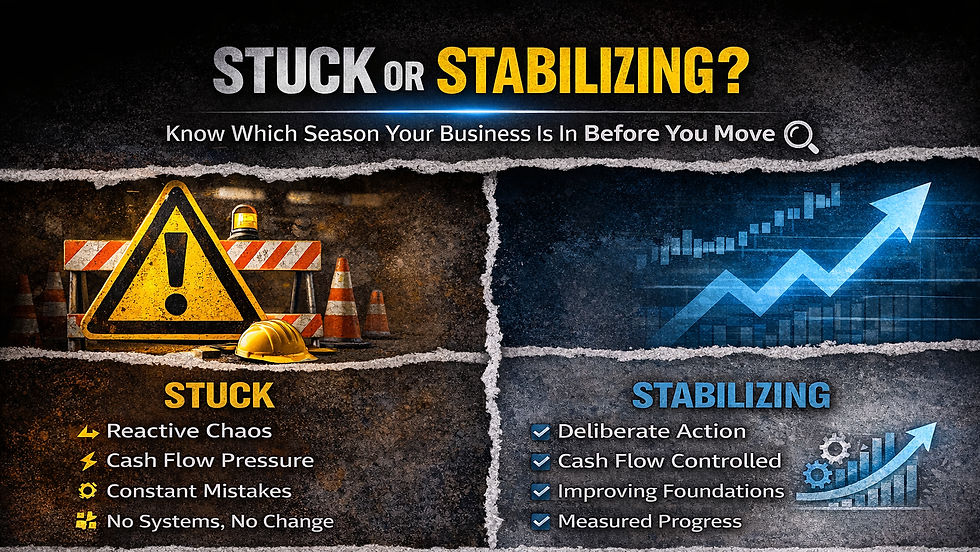
All businesses experience slow periods, operational chaos, or revenue plateaus. When this happens, most owners panic and label themselves “stuck.”
But here’s the truth: most businesses are not truly stuck—they are stabilizing. Stabilization is a deliberate season of correcting weaknesses, building systems, and preparing for sustainable growth. Misreading your season leads to stress, poor decisions, and wasted energy—but recognizing it gives clarity, control, and a path forward.
This guide is designed to give you:
A full framework to distinguish Stuck vs Stabilizing
A clear understanding of the symptoms, operational patterns, and emotional signals
Concrete corrective actions for each season
Confidence to act deliberately instead of reactively

Understanding “Being Stuck”
Being stuck is not just “slow growth”—it is a pattern of recurring breakdowns, missed opportunities, and ineffective actions.
Core Characteristics:
Repeating Mistakes: You fix the same problem over and over because there is no systemic solution.
Cash Flow Chaos: Money comes and goes unpredictably. Bills pile up, and financial pressure dictates your every move.
Decision Paralysis: You avoid or delay decisions because nothing seems to make a lasting difference.
Team Disruption: Employees are frustrated, unclear on priorities, and constantly firefighting.
Missed Opportunities: Growth opportunities are ignored, mismanaged, or executed poorly.
Emotional Impact: Daily operations feel exhausting, progress seems invisible, and stress is constant.
Example: You notice recurring customer complaints. You address them temporarily, but the next month, the same issues appear. Staff are frustrated, cash flow is unpredictable, and your energy is drained. That is stuck—a cycle repeating until root causes are addressed.
How to Diagnose Stuck:
Track recurring operational failures. Ask: Why does this keep happening?
Review cash flow trends for patterns of inconsistency.
Audit team responsibilities and communication for misalignment.
Identify delayed or avoided decisions and their consequences.
Map opportunities missed and determine why they weren’t executed successfully.
Corrective Actions for Stuck Businesses:
Document Every Process: Standardize workflows to prevent repeat failures.
Stabilize Cash Flow: Prioritize immediate financial clarity and solvency.
Set Accountability: Define roles, responsibilities, and metrics for your team.
Correct Operational Weaknesses: Implement permanent fixes, not temporary patches.
Seek Structured Guidance: External assessments, mentors, or coaching can accelerate clarity.
Relief Moment: Recognizing that you’re stuck is the first step to regaining control. Once you understand the cycle, you can break it and regain stability.

Understanding “Stabilizing”
Stabilizing is a season of deliberate improvement and preparation for growth. It may feel slower because it focuses on correcting internal systems and aligning resources.
Core Characteristics:
Systematic Process Building: Workflows are documented, refined, and standardized to reduce errors.
Financial Discipline: Budgets, cash flow, and margins are monitored closely.
Measured Decision-Making: Decisions take longer but are guided by data, patterns, and projected outcomes.
Team Alignment: Roles, responsibilities, and communication are clarified, creating accountability and cohesion.
Foundation First: Marketing, sales, or scaling may pause while backend systems are strengthened.
Emotional Experience: Stabilizing can feel uncomfortable because progress is mostly internal—but results are measurable and lasting.
Example: Your business had recurring product delivery delays. During stabilization, you document the entire supply chain, train the team, and monitor metrics weekly. Cash flow is steady, team members know responsibilities, and mistakes are decreasing. Outward growth may look small, but the foundation is strengthening.
Actions for Stabilizing Businesses:
Continue Refining Systems: Document and optimize every key workflow.
Track Metrics: Cash flow, margins, and operational KPIs should be monitored consistently.
Deliberate Decision-Making: Make choices slowly, guided by data and risk assessment.
Prepare Teams for Growth: Ensure the team can execute at scale once foundation is solid.
Measure Internal Wins: Track process improvements, error reductions, and accountability milestones—even if revenue growth is slow.
Relief Moment: Stabilization is not failure. It is the season that makes future growth sustainable. Understanding this prevents panic, misguided action, or premature scaling.
Recognizing the Differences: A Quick Framework
Indicator | Stuck | Stabilizing |
Mistakes | Repeat endlessly | Corrected and monitored |
Cash Flow | Chaotic | Controlled and improving |
Decision-Making | Delayed, reactive | Measured, intentional |
Team | Frustrated, firefighting | Aligned, accountable |
Opportunity | Ignored or poorly executed | Strategically evaluated |
Emotional Signal | Overwhelm, panic | Discomfort, focused |
Tip: Look for patterns, not isolated incidents. Stuck is repetitive and reactive; stabilizing is intentional and corrective.
How to Diagnose Your Season
Ask yourself these questions:
Are recurring problems actively being addressed?
Do problems repeat without permanent correction?
Are decisions guided by data, metrics, and patterns instead of emotion?
Is chaos the default operational state?
Are internal improvements visible, even if outward results are slow?
Rule of Thumb:
Stabilizing = deliberate season of improvement
Stuck = repeating cycle until corrective action is applied
Pro Insight: For a full, data-driven view of your business, the EDGE Assessment identifies patterns and reveals whether your business is stuck or stabilizing, giving a roadmap for actionable next steps.
Corrective Strategies for Each Season
If You’re Stuck:
Map recurring failures and their root causes.
Standardize and document all processes.
Prioritize cash flow stability and margin control.
Implement team accountability measures.
Seek structured external guidance or assessments.
If You’re Stabilizing:
Refine systems and workflows for efficiency and consistency.
Track financial metrics closely and adjust proactively.
Make deliberate, data-informed decisions.
Train your team for consistent execution at scale.
Track progress, celebrate small wins, and prepare for growth.
Relief Moment: Both seasons have a clear path forward. Even if you are currently stuck, there is a defined way to regain control. If you are stabilizing, you can proceed confidently knowing every step strengthens your foundation.
Why This Matters
Misreading your business season leads to wasted effort, misaligned priorities, and avoidable stress. Correctly diagnosing it allows you to:
Prevent premature scaling
Avoid panic-driven decisions
Align your team for effective execution
Focus on building systems that create long-term growth
Recognizing the season your business is in provides clarity, relief, and actionable steps to move forward with confidence.
The Bottom Line
Stuck = reactive cycle that repeats until addressed
Stabilizing = deliberate season of preparation and correction
Both require different actions, and both have a clear path forward
Understanding your season transforms frustration into clarity and chaos into actionable progress.
Next Step: To fully understand where your business is and uncover the patterns guiding your next moves, consider the EDGE Assessment. It’s a structured, objective way to see your business clearly, identify weaknesses, and move deliberately from reactive cycles into controlled growth.


Comments